

How to Choose the Right Mutual Fund Portfolio for Your Investment Goals
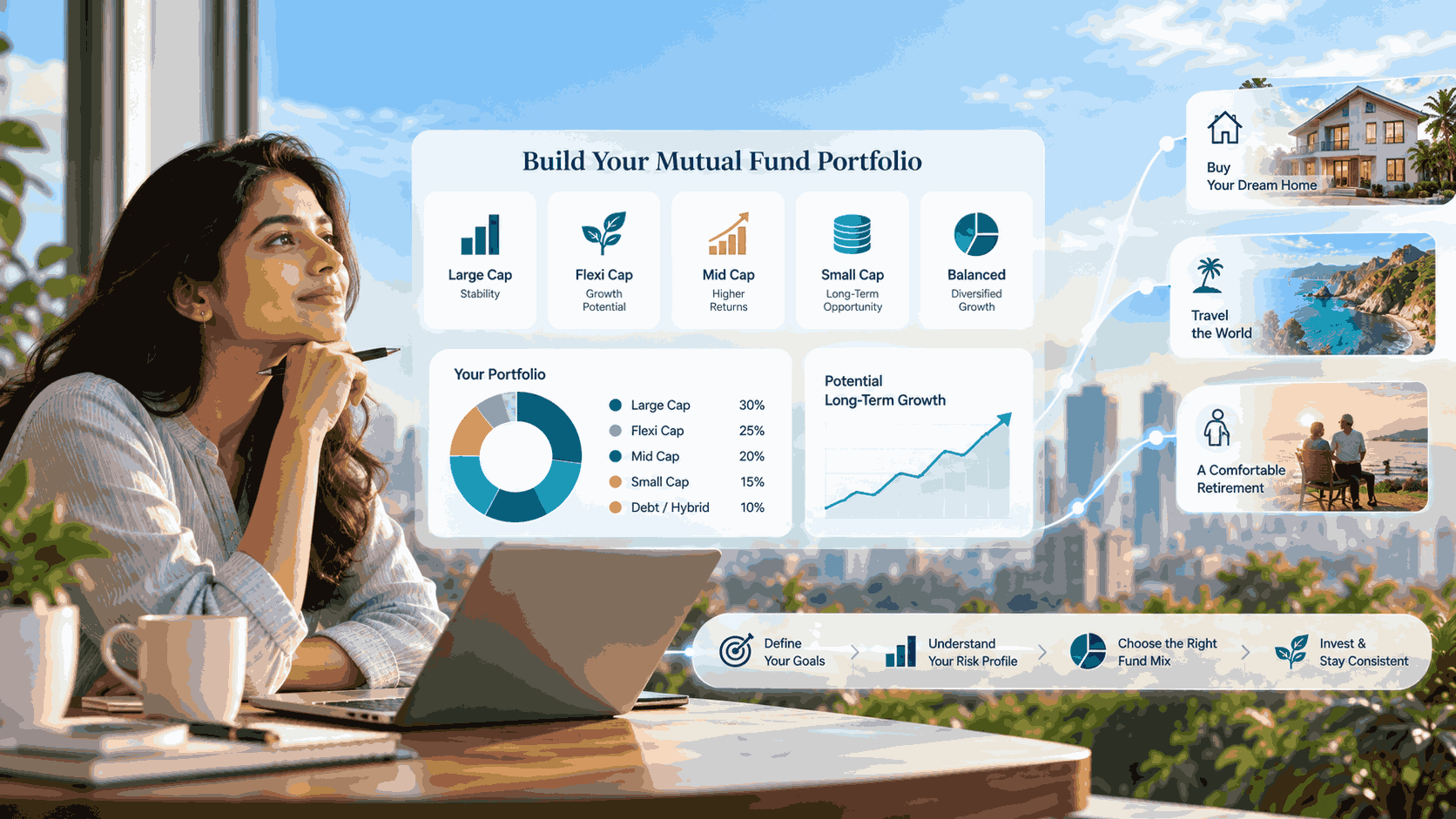
Imagine you decide to start investing ₹20,000 every month from now.
You open a app that sells mutual fund and start exploring the pletora of the funds available. One fund has delivered impressive returns over the past year. Another has a full five star rating. A third is being recommended by a friend or a fincluencer. Before you know it, you would have shortlisted multiple funds, but you are still unsure which ones to choose.
Have you been in such situatio or does the feeling sound familiar?
Choosing mutual funds has become much easier. Building the right portfolio, however, is a completely different story.
India offers investors thousands of mutual fund schemes across Equity, Debt, Hybrid, Index categories and what not. The challenge is not to simply find a good fund. It is figuring out which funds work well together, how much to invest in each, and whether the overall portfolio supports your financial goals.
A collection of good mutual funds does not automatically make a good portfolio.
Let us look at how to choose a mutual fund portfolio that fits your life, your financial goals and your comfort with risk.
1. Start With Your Financial Goals, Not Fund Rankings
Before comparing returns, ask yourself one question: What am I investing for?
Your answer should influence almost every investment decision that follows.
Consider three investors:
-
Riya wants to buy a house in two years. She needs to protect money she will soon require, so taking substantial equity risk may not suit her goal.
-
Aman is saving for his child's education in ten years. He has more time to invest, which may allow him to consider a diversified, growth oriented portfolio.
-
Neha is investing for retirement in 25 years. Her long horizon gives her more time to navigate market fluctuations, although her risk tolerance and financial responsibilities still matter.
All three could invest in mutual funds, but they should not necessarily choose the same portfolio.
Start by identifying your goal, the amount you need and when you sould be needing the money. Then select investments that fit that timeline.
2. Match Your Portfolio to Your Risk Tolerance
Knowing your goal is only half the job. You also need to understand how much risk you can afford to take and how much volatility you can comfortably handle.
These aren't the same thing.
You might have 20 years until retirement, but if a market decline would force you to sell your investments in panic, an extremely aggressive portfolio may not be suitable.
Broadly, mutual fund portfolios can be approached in three ways:
-
Conservative: Emphasises stability and lower volatility, often through debt oriented investments. These investments still carry risks, including interest rate and credit risk.
-
Moderate: Balances growth potential with relatively more stable investments.
-
Growth-oriented: Places greater emphasis on equities to pursue long term growth, accepting potentially larger short term declines.
These are broad descriptions, not fixed portfolio recipes. Your income stability, emergency savings, existing investments and financial obligations also matter.
The right portfolio is one you can afford to hold through difficult markets without abandoning your plan.
3. Review What You Already Own Before Buying More
If you have been investing for a while, do not assume you need to start from scratch.
Your existing portfolio may already contain suitable investments. The first step is understanding what you own.
Review these five things:
Fund category: Are your investments spread across appropriate categories, or are they concentrated in one type of fund?
Portfolio overlap: Do several funds hold many of the same underlying stocks?
Risk exposure: Is your portfolio taking more risk than you intended?
Costs: Are you paying attention to expense ratios and any applicable advisory or transaction charges?
Goal alignment: Do your investments still match your financial goals and time horizon?
For example, an investor might own two large cap funds, two flexi cap funds and an index fund. Five schemes may look diversified on paper, but their underlying holdings could overlap considerably.
The result may be more complexity without much additional diversification.
Before adding another fund, understand what it contributes to your overall portfolio.
4. How Many Mutual Funds Should You Own?
There's no universal number that suits every investor.
A simple portfolio with a few complementary funds can be easier to understand and monitor than one containing 15 schemes. On the other hand, the right number depends on the investor's goals, portfolio size and investment strategy.
The important question isn't how many funds you own. It's whether each fund serves a distinct purpose.
Before adding a new scheme, ask:
-
Does it provide exposure I do not already have?
-
Does it fit my investment horizon?
-
Does it improve diversification?
-
Do I understand its strategy and risks?
-
Will it make my portfolio unnecessarily complicated?
If you can not explain why a fund belongs in your portfolio, pause before investing.
More funds automatically does not mean less risk. Better portfolio construction matters more than the number of schemes.
5. Understand How Different Portfolio Approaches Work
Once you identify your goals and risk tolerance, you can decide how to build and manage your portfolio.
Here are three approaches worth considering.
Option A: Build Your Own Portfolio
DIY investing gives you control over fund selection, allocation and portfolio changes.
You research schemes, compare costs, study their investment strategies and decide when to review your holdings.
This approach may suit investors who enjoy financial research and have the time to monitor their investments.
The trade-off is responsibility. You need to understand portfolio overlap, risk, fund performance and when a change is genuinely necessary.
Option B: Choose a Curated MF Basket
What if you do not select every fund individually?
A curated mutual fund basket brings together multiple schemes within a portfolio designed around a particular investment objective, theme or risk profile.
Instead of choosing funds one by one, you evaluate which basket best fits your needs.
MF Baskets by 5nanceAI offer curated portfolios of Direct Mutual Funds. They can be useful for investors who want a more structured starting point without independently assembling every part of their portfolio.
However, a curated basket isn't automatically right for everyone. Review its investment objective, underlying schemes, risks, costs and suitability before investing.
Option C: Explore AI-Assisted Mutual Fund Advisory
Some investors are comfortable investing but don't want to spend hours monitoring fund performance and researching potential changes.
This is where AI assisted mutual fund advisory may help.
Algrow by 5nance uses algorithms to analyse mutual fund opportunities and provides a structured approach to fund selection and switching.
Rather than expecting investors to monitor every scheme themselves, the service aims to make ongoing fund management more systematic.
AI doesn't eliminate market risk or guarantee better returns. Its value depends on the methodology, data and investment process behind it, as well as whether the approach suits your goals.
6. DIY vs MF Baskets vs Algrow: Which Approach Fits You?
| Factor | DIY Investing | MF Baskets | Algrow |
|---|---|---|---|
| Fund selection | You research and choose | Curated portfolio | Algorithm-assisted fund selection |
| Portfolio construction | Your responsibility | Structured basket | Structured advisory approach |
| Ongoing involvement | Depends on your process | Review the basket periodically | Includes fund monitoring and switching |
| Best suited to | Investors who want direct control | Investors seeking a curated starting point | Investors seeking AI-assisted mutual fund advisory |
| Key consideration | Time and research required | Basket suitability and costs | Advisory fees, methodology and market risk |
These approaches serve different needs. None guarantees superior returns, and the right choice depends on your experience, preferences and financial circumstances.
7. Your Mutual Fund Portfolio Checklist
Before investing in a new portfolio or changing an existing one, work through this checklist:
-
Have I clearly defined my financial goal?
-
Is my investment horizon realistic for the level of risk I'm taking?
-
Does my portfolio match my risk tolerance?
-
Have I checked overlap between my existing funds?
-
Do I understand the role of every fund in the portfolio?
-
Have I compared expense ratios and applicable advisory charges?
-
Do I have adequate emergency savings for unexpected expenses?
-
Have I decided when and how I'll review the portfolio?
-
Am I making this decision based on my goals rather than recent returns?
You don't need to find the perfect portfolio on day one. You need a sensible starting point and a process for reviewing it as your circumstances change.
How 5nance Can Help You Take the Next Step
Choosing mutual funds is only one part of investing. The bigger challenge is bringing those choices together into a portfolio you understand and can maintain over time.
If you prefer a curated approach, explore 5nance MF Baskets to understand how selected Direct Mutual Funds can be combined into a structured portfolio.
If you'd prefer technology-assisted fund selection and ongoing monitoring, explore Algrow to learn how AI-assisted mutual fund advisory works.
Before choosing either, review the investment approach, eligibility requirements, applicable charges and risks to decide whether it fits your needs.
Final Thoughts
The best mutual fund portfolio isn't necessarily the one with the highest recent returns or the greatest number of schemes.
It's the one built around your goals, appropriate for your risk tolerance and structured so you can stay invested through changing market conditions.
Start with what you're trying to achieve. Understand what you already own. Avoid unnecessary overlap. Choose an investment approach you can follow consistently, and review your portfolio when your goals or circumstances change.
Because successful investing isn't about collecting mutual funds.
It's about making your investments work together toward something that matters to you.
Disclaimer: Mutual fund investments are subject to market risks. Read all scheme-related documents carefully before investing. Past performance does not guarantee future returns. This article is for educational purposes and should not be considered personalised investment advice.

