

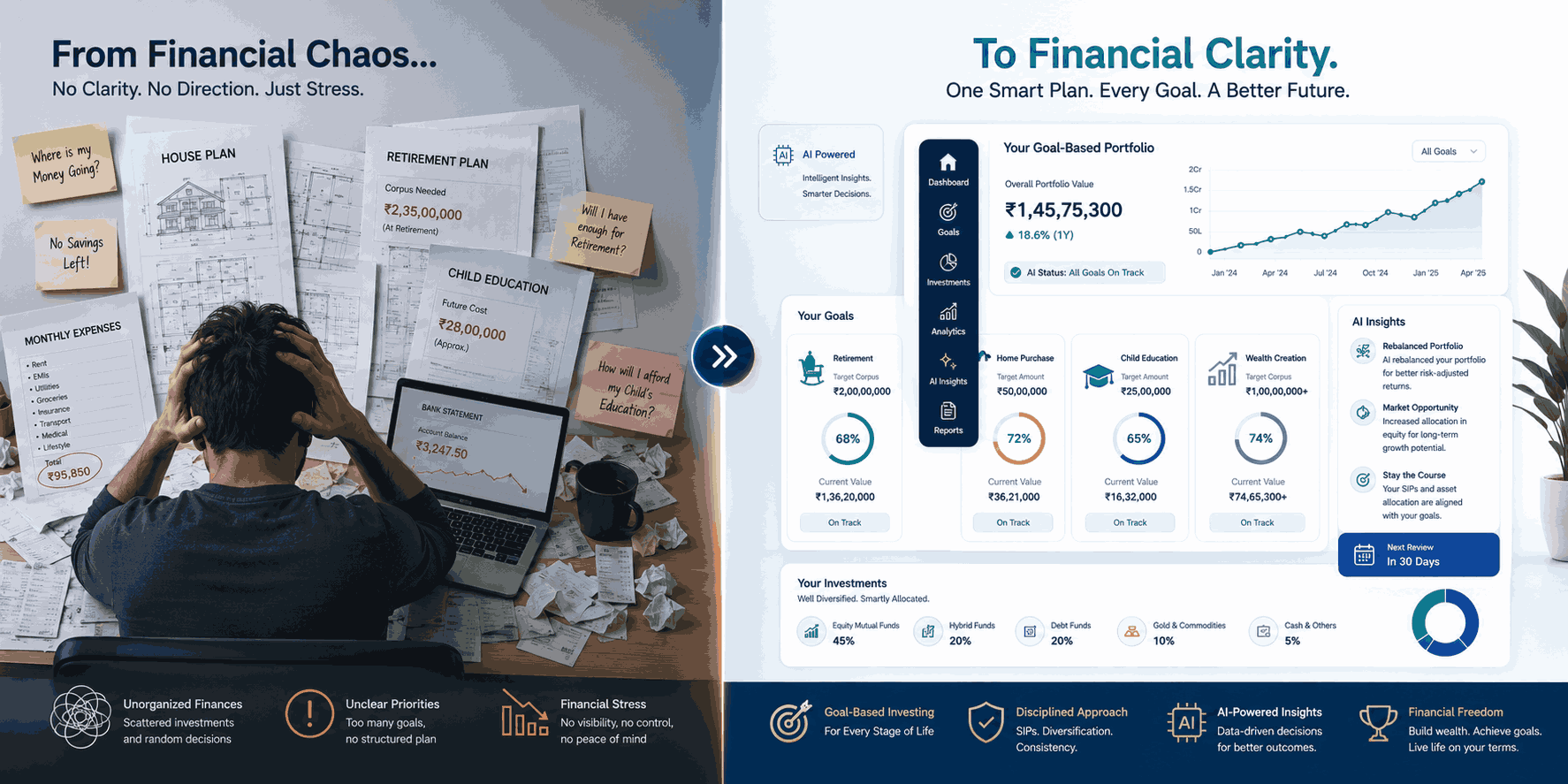
One Salary. Multiple Dreams. So Where Should Your Money Go?
Imagine this.
You're in your early 30s.
You want to buy a home in the next five years.
Your child's education is a priority.
Retirement is still 25 years away but you know you can't ignore it.
You'd also like to take an international vacation every couple of years and build an emergency fund.
Sounds familiar?
Most investors don't struggle because they lack goals.
They struggle because they have too many.
And that's actually a good problem to have.
The challenge isn't setting financial goals.
The challenge is deciding how to invest for all of them without sacrificing one for another.
Many people assume they need to achieve one goal before starting another.
But that's rarely how life works.
Your retirement won't wait until your home loan is paid off.
Your child's education won't pause because you're saving for a house.
Financial planning today is less about choosing between goals and more about managing multiple goals simultaneously.
The good news?
With the right strategy, it's entirely possible.
Stop Thinking About Investments. Start Thinking About Goals.
One of the biggest mistakes investors make is building investments first and assigning goals later.
Instead, flip the process.
Every rupee you invest should have a purpose.
Ask yourself:
-
Why am I investing?
-
When will I need this money?
-
How much money will I need?
Once you answer these questions, your investments become much easier to organize.
Think of your financial goals as different buckets.
Each bucket has a different timeline and a different purpose.
For example:
Short-Term Goals (0–3 Years)
-
Emergency fund
-
Vacation planning
-
Buying a vehicle
-
Home down payment
Medium-Term Goals (3–7 Years)
-
Buying a home
-
Starting a business
-
Child's early education
Long-Term Goals (7+ Years)
-
Retirement
-
Child's higher education
-
Wealth creation
-
Financial independence
The timeline often determines the investment approach more than the goal itself.
Not Every Goal Deserves Equal Priority
Here's an uncomfortable truth.
Some goals are more important than others.
That doesn't mean you abandon certain goals.
It means you prioritize wisely.
For example:
Buying a luxury car may be desirable.
Building a retirement corpus is essential.
An international vacation is exciting.
An emergency fund is necessary.
A useful exercise is to categorize goals into three groups:
Essential Goals
These are goals that directly impact your financial security.
Examples:
-
Retirement
-
Emergency fund
-
Child's education
-
Health-related goals
Important Goals
Goals that improve your lifestyle but aren't critical.
Examples:
-
Home purchase
-
Business expansion
-
Major renovations
Lifestyle Goals
Goals that enhance experiences.
Examples:
-
Vacations
-
Luxury purchases
-
Hobby-related spending
When resources are limited, essential goals should always be funded first.
The Biggest Mistake: Using the Same Investment for Every Goal
Imagine using the same vehicle for every journey.
A motorcycle for a family vacation.
A truck for grocery shopping.
A sports car for off-road driving.
It wouldn't make much sense.
Yet investors often use the same investment strategy for every financial goal.
Different goals require different levels of risk and liquidity.
For example:
Money needed within two years should generally be invested differently from money meant for retirement 25 years later.
The closer a goal is, the more important capital preservation becomes.
The farther away a goal is, the more time investments have to potentially benefit from long-term growth.
Successful investing isn't just about choosing investments.
It's about matching investments to the right goals.
Create Separate Goal-Based Portfolios
One of the simplest ways to manage multiple goals is to stop viewing your investments as one giant portfolio.
Instead, mentally divide them into goal-specific portfolios.
For example:
Portfolio 1: Retirement
Time Horizon: 25 years
Objective: Long-term growth
Portfolio 2: Child's Education
Time Horizon: 12 years
Objective: Growth with gradual risk reduction as the goal approaches
Portfolio 3: Home Purchase
Time Horizon: 5 years
Objective: Capital appreciation while preserving stability
When each goal has its own strategy, tracking progress becomes much easier.
More importantly, you avoid making emotional decisions.
A market correction may not affect your home-buying fund and retirement portfolio in the same way.
Treating them separately helps maintain perspective.
Inflation Changes Everything
Many investors underestimate how much future goals will actually cost.
Let's take a simple example.
A college education costing ₹20 lakh today may cost significantly more 15 years from now due to inflation.
The same applies to:
-
Healthcare
-
Real estate
-
Travel
-
Retirement expenses
This is why goal-based planning should always account for inflation.
Otherwise, you may successfully achieve today's target while falling short of tomorrow's reality.
When planning for long-term goals, it's not enough to ask:
How much do I need today?
You must ask:
How much will I need when the goal actually arrives?
Automate Your Investments
One reason investors struggle with multiple goals is decision fatigue.
Every month becomes a negotiation.
Should I invest?
Should I save?
Should I spend?
Automation solves this problem.
By setting up automated investments toward different goals, you remove emotions from the process.
Your investments continue regardless of:
-
Market noise
-
News headlines
-
Temporary uncertainty
Consistency is often more important than perfection.
The most successful investors aren't necessarily the smartest.
They're usually the most disciplined.
Review Goals Every Six Months
Life rarely follows a straight line.
Your salary changes.
Your family grows.
Priorities shift.
Financial goals evolve.
That's why reviewing your goals regularly is just as important as investing.
Every six months, ask yourself:
-
Has my target amount changed?
-
Am I on track?
-
Have my priorities shifted?
-
Do I need to increase contributions?
Think of it like using GPS navigation.
The destination remains the same, but the route may need adjustments along the way.
How AI Can Simplify Multi-Goal Investing
Managing one investment goal is relatively straightforward.
Managing five or six simultaneously becomes more complex.
Each goal has:
-
Different timelines
-
Different risk levels
-
Different return expectations
-
Different liquidity needs
This is where AI-powered investing can help.
Instead of manually tracking every portfolio and constantly adjusting allocations, AI can continuously evaluate:
-
Portfolio diversification
-
Goal progress
-
Risk exposure
-
Asset allocation
-
Market conditions
Rather than reacting emotionally to short-term market movements, investors can stay focused on long-term objectives.
How 5nance Helps Investors Manage Multiple Goals
At 5nance, we often see investors struggle not because they lack ambition, but because they're trying to achieve several goals at once.
Whether it's retirement planning, wealth creation, a child's education, or purchasing a home, each goal requires a different investment approach.
Our AI-powered solutions help investors create more structured, goal-oriented portfolios by continuously monitoring allocation, diversification, and risk.
Instead of managing investments based on market headlines, investors can focus on what truly matters: achieving their financial goals.
Frequently Asked Questions
Can I invest for multiple financial goals at the same time?
Yes. Most investors have several financial goals simultaneously. The key is prioritizing goals, assigning timelines, and creating separate investment strategies for each objective.
Which goal should I prioritize first?
Essential goals such as retirement, emergency funds, and children's education generally deserve priority because they directly affect long-term financial security.
Should every goal have a separate investment?
Not necessarily separate investments, but each goal should have a clear allocation strategy based on its timeline, risk profile, and objective.
How often should I review my goals?
A review every six to twelve months is generally sufficient unless there's a major life event such as marriage, a new job, or a significant financial change.
How does AI help with goal-based investing?
AI can monitor multiple portfolios simultaneously, track progress toward goals, evaluate risk exposure, and recommend adjustments based on changing market conditions and financial objectives.
Final Thoughts
Financial success isn't about choosing between goals.
It's about creating a system that allows multiple goals to progress together.
The house you want to buy.
The retirement you envision.
The education you want to provide your children.
The financial freedom you're working toward.
All of these goals can coexist.
The key is giving every goal a purpose, a timeline, and a strategy.
Because the investors who achieve their goals aren't necessarily the ones who earn the highest returns.
They're the ones who plan for life's priorities before life demands them.
Want to see if your investments are aligned with your financial goals? Explore 5nance's AI-powered Wealth Solutions and discover how goal-based investing can help you build a clearer path toward financial freedom.


