

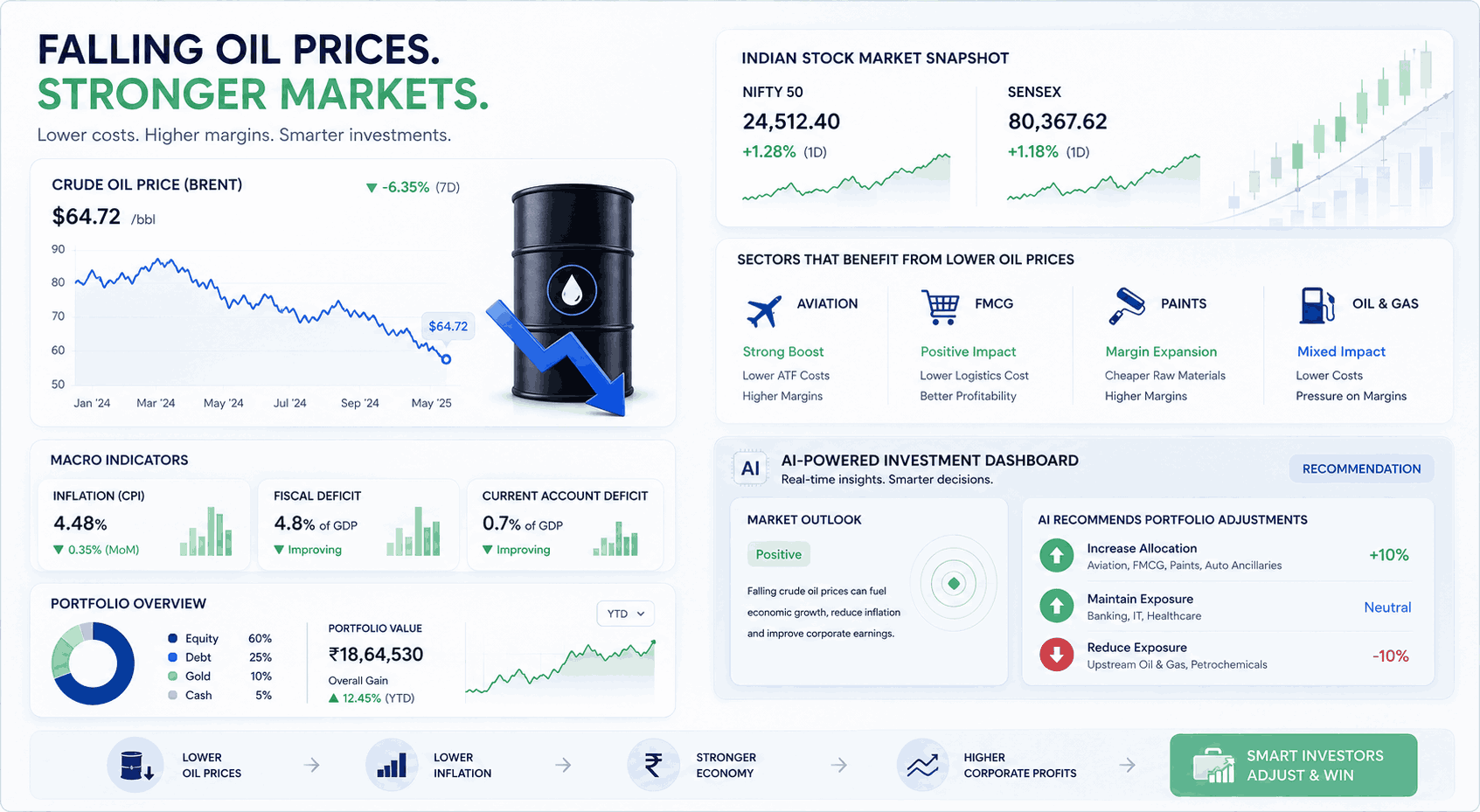
What Falling Oil Prices Mean for Investors
Oil is often called the lifeblood of the Global Economy.
Almost everything we use, from transportation and manufacturing to logistics and electricity, is directly or indirectly influenced by crude oil prices.
That's why whenever headlines announce that crude oil prices are falling, investors immediately begin asking:
-
Is this good or bad for the stock market?
-
Which sectors will benefit?
-
Should I change my portfolio?
-
Is this the right time to invest?
The answer isn't as simple as "lower oil prices are good."
While cheaper crude can reduce inflation, improve corporate profitability, and lower import bills, it can also signal slowing global demand or weaker economic activity.
For investors, the key is understanding why oil prices are falling and how different sectors respond.
In this guide, we'll explain what falling oil prices mean for investors, which industries stand to gain or lose, and how a disciplined investment strategy can help navigate these changing market conditions.
Who Is This Guide For?
This article is particularly useful for:
-
Retail investors tracking market news
-
Mutual fund investors wondering how macroeconomic events affect portfolios
-
Stock market beginners trying to understand sector movements
-
Long-term investors looking to position their portfolios strategically
-
Anyone interested in understanding how global events influence Indian investments
It doesn’t matter if you invest through SIPs, direct equities, or diversified portfolios, understanding crude oil prices can help you make more informed investment decisions.
Why Do Oil Prices Fall?
Before deciding whether falling oil prices are positive or negative, it's important to understand what caused the decline.
Crude oil prices can fall for several reasons.
1. Lower Global Demand
When economic growth slows, industries produce less, people travel less, and demand for fuel declines.
Lower demand often pushes oil prices down.
2. Increased Oil Supply
If major oil-producing countries increase production while demand remains unchanged, prices generally decline due to excess supply.
3. Geopolitical Developments
Conflicts, sanctions, trade agreements, and diplomatic decisions can quickly change expectations about future oil supply.
Markets react almost instantly.
4. Stronger US Dollar
Since crude oil is priced globally in US dollars, a stronger dollar can sometimes put downward pressure on commodity prices.
Understanding why prices are falling is often more important than simply knowing that they have fallen.
Why Oil Prices Matter So Much for India
India imports nearly 85% of its crude oil requirement, making it one of the world's largest oil importers.
This means oil prices influence:
-
Fuel prices
-
Transportation costs
-
Inflation
-
Corporate profitability
-
Government finances
-
Current account deficit
-
Consumer spending
Even people who don't own vehicles are affected because transportation costs influence the prices of everyday goods and services.
For investors, falling crude prices can create ripple effects across multiple sectors of the economy.
How Falling Oil Prices Affect the Indian Economy
Lower Inflation
One of the biggest advantages of falling crude oil prices is reduced inflationary pressure.
Lower fuel costs can gradually reduce:
-
Transportation expenses
-
Manufacturing costs
-
Logistics costs
Businesses may benefit from improved margins, while consumers may have more disposable income.
Lower inflation can also create a more supportive environment for economic growth.
Improved Trade Balance
Since India imports a significant portion of its crude oil, lower prices reduce the country's import bill.
This can help:
-
Improve the current account balance
-
Reduce pressure on foreign exchange reserves
-
Support macroeconomic stability
A stronger economic environment often benefits financial markets over the long term.
Potential Interest Rate Impact
When inflation eases, central banks may have greater flexibility in monetary policy.
While interest rate decisions depend on multiple factors, lower inflation can improve the outlook for borrowers, businesses, and investors.
Which Sectors Benefit from Falling Oil Prices?
Not every industry responds the same way.
Some sectors benefit significantly, while others may face challenges.
1. Aviation
Airlines are among the biggest beneficiaries.
Fuel represents one of the largest operating costs for airline companies.
Lower aviation fuel prices can improve profitability if passenger demand remains stable.
2. Paint Companies
Paint manufacturers use crude oil derivatives as key raw materials.
Lower input costs may improve operating margins and profitability.
3. FMCG Companies
Fast-moving consumer goods companies rely heavily on transportation and packaging.
Lower logistics costs can positively impact margins, particularly for companies with extensive distribution networks.
4. Logistics and Transportation
Courier services, trucking companies, shipping businesses, and logistics providers often benefit from lower fuel expenses.
Reduced operating costs can improve earnings over time.
5. Automobile Sector
While the impact varies across manufacturers, lower fuel prices can encourage vehicle usage and improve consumer sentiment.
Demand for certain vehicle categories may improve under favorable economic conditions.
Which Sectors May Face Challenges?
Falling crude prices are not universally positive.
Some industries may experience headwinds.
Oil Exploration and Production Companies
Companies involved in crude oil production may face lower realizations for their output.
Reduced selling prices can affect revenue and profitability.
Oilfield Services
Businesses providing drilling, exploration, and energy-related services may experience reduced activity if producers cut investments.
Commodity-Linked Businesses
Companies closely tied to energy prices may experience greater earnings volatility during prolonged periods of lower crude prices.
What Does This Mean for Stock Market Investors?
Many investors assume:
"Oil prices are falling, so the entire stock market should go up."
Reality is more nuanced.
Different sectors react differently.
For example:
|
Sector |
Likely Impact |
|
Aviation |
Positive |
|
FMCG |
Positive |
|
Paints |
Positive |
|
Logistics |
Positive |
|
Oil Exploration |
Negative |
|
Refining |
Mixed |
|
Auto |
Generally Positive |
|
Banking |
Indirectly Positive through improved economic outlook |
This highlights an important investing principle:
Macroeconomic events rarely affect every company equally.
Successful investors focus on understanding how changing economic conditions influence different businesses rather than reacting to headlines alone.
Does Falling Oil Always Mean Higher Stock Market Returns?
Not necessarily.
The context matters.
Scenario 1: Falling Oil Due to Higher Supply
This is often viewed more positively because businesses benefit from lower input costs while economic activity remains healthy.
Scenario 2: Falling Oil Due to Weak Global Demand
This can be less encouraging.
If oil prices fall because economies are slowing, corporate earnings across many industries may also weaken.
This is why investors should avoid making investment decisions based solely on crude oil prices.
Instead, they should evaluate the broader economic picture.
How Should Mutual Fund Investors Respond?
If you invest through mutual funds, falling oil prices don't necessarily mean you should rush to buy or sell your investments. Instead, it's an opportunity to review whether your portfolio is aligned with the current economic environment and your long-term financial goals.
Different types of mutual funds may respond differently to changing oil prices:
-
Large-cap funds may benefit from stronger earnings in sectors such as banking, FMCG, and automobiles.
-
Sectoral funds focused on aviation, logistics, or consumer businesses may see improved prospects if lower fuel costs support profitability.
-
Energy or commodity-focused funds could face headwinds if oil producers experience lower revenues.
-
Diversified equity funds are generally better positioned to absorb sector-specific volatility because they invest across multiple industries.
Rather than reacting to short-term market movements, investors should continue evaluating whether their portfolio remains diversified and suited to their investment objectives.
Should You Change Your Investment Strategy?
Market events often tempt investors to make sudden portfolio changes.
However, successful investing is rarely about responding to every headline. Instead, it's about having a disciplined strategy that adapts thoughtfully to changing conditions.
When oil prices decline, consider asking yourself:
-
Is my portfolio overly concentrated in one sector?
-
Has my asset allocation drifted away from my target?
-
Are my investments still aligned with my long-term goals?
-
Am I making decisions based on data or emotions?
These questions often matter far more than trying to predict the next move in crude oil prices.
The Importance of Diversification During Market Cycles
One lesson that every experienced investor learns is that no single sector outperforms forever.
Today's winners may become tomorrow's laggards.
For example:
-
During periods of high oil prices, energy companies may outperform.
-
During periods of lower oil prices, consumer-facing businesses and transportation companies may benefit.
-
At other times, technology, healthcare, or financial services may lead the market.
Trying to rotate between sectors based on short-term news can be difficult, even for experienced investors.
A diversified portfolio helps reduce dependence on any single economic trend while allowing investors to participate in opportunities across multiple sectors.
How AI Can Help Investors Navigate Changing Market Conditions
One of the biggest challenges investors face isn't a lack of information—it's deciding what to do with it.
Every day brings new headlines about:
-
Oil prices
-
Inflation
-
Interest rates
-
Global conflicts
-
Corporate earnings
-
Currency movements
Reacting emotionally to every development can lead to inconsistent investment decisions.
This is where AI-powered investing can provide significant value.
Instead of focusing on a single data point, AI evaluates multiple market indicators together, helping investors make more balanced, objective decisions.
Example: Smarter Portfolio Management with All Rounder
Imagine two investors with similar portfolios.
Investor A
Follows financial news daily and frequently changes investments whenever major economic events occur.
When oil prices fall, they immediately reduce exposure to energy companies and increase investments elsewhere without evaluating the broader portfolio.
Investor B
Uses All Rounder, 5nance's AI-powered multi-asset investment solution.
Rather than reacting to headlines alone, All Rounder continuously evaluates:
-
Market trends
-
Asset allocation
-
Risk exposure
-
Portfolio diversification
-
Changing economic conditions
Based on predefined investment frameworks, the portfolio is reviewed and adjusted periodically rather than emotionally.
The objective isn't to predict every market movement.
It's to help investors remain disciplined while adapting to evolving market conditions.
Who Is This Investment Approach Best Suited For?
Understanding the impact of oil prices can benefit a wide range of investors, including:
First-Time Investors
If you're new to investing, this knowledge helps you understand why different sectors react differently to economic events.
Long-Term Wealth Builders
Investors focused on goals such as retirement, children's education, or wealth creation can benefit from staying disciplined instead of reacting to short-term headlines.
Mutual Fund Investors
Knowing how macroeconomic factors influence different industries can help you better understand the performance of your funds.
Equity Investors
Stock market participants can use this understanding to evaluate businesses beyond short-term price movements.
What Problems Does This Guide Solve?
Many investors feel overwhelmed whenever major economic news dominates headlines.
Questions such as:
-
"Should I sell my investments?"
-
"Will lower oil prices hurt the market?"
-
"Which sectors should I invest in now?"
-
"Should I change my mutual funds?"
are common.
This guide provides a structured framework for interpreting falling oil prices without making impulsive decisions.
Rather than focusing on short-term market noise, it encourages investors to evaluate the broader economic context and maintain a long-term perspective.
How Does This Compare to Common Investment Approaches?
|
Approach |
Advantages |
Limitations |
|
Reacting to News Headlines |
Immediate action |
Can lead to emotional decisions |
|
Sector Chasing |
Potential short-term gains |
Higher concentration risk |
|
Passive Long-Term Investing |
Simplicity and consistency |
May require periodic portfolio reviews |
|
AI-Assisted Investing |
Data-driven portfolio monitoring, diversification, and disciplined decision-making |
Requires choosing a trusted investment platform |
For many investors, combining long-term investing principles with technology-driven portfolio management offers a balanced approach.
Why You Can Trust This Recommendation
This article is based on widely accepted investing principles rather than short-term market predictions.
The guidance focuses on:
-
Diversification
-
Long-term investing
-
Portfolio reviews
-
Risk management
These principles have remained relevant across multiple market cycles, regardless of whether oil prices are rising or falling.
While no investment strategy can eliminate market risk or guarantee returns, maintaining a disciplined investment process has historically helped investors navigate changing economic environments more effectively.
Frequently Asked Questions (FAQs)
Do falling oil prices always benefit the stock market?
No. The impact depends on why oil prices are falling. Lower prices driven by increased supply can support economic growth, while declines caused by weak global demand may indicate broader economic challenges.
Which sectors usually benefit from lower crude oil prices?
Industries such as aviation, logistics, paints, FMCG, and certain automobile companies often benefit from lower fuel and raw material costs.
Should I sell energy stocks when oil prices fall?
Not necessarily. Investment decisions should be based on a company's fundamentals, valuation, and your long-term goals rather than a single macroeconomic event.
How do lower oil prices affect mutual funds?
The impact depends on the sectors represented within the fund. Diversified mutual funds may experience both positive and negative effects across different holdings.
Can AI help investors during changing market conditions?
AI can assist by continuously evaluating multiple market indicators, portfolio risk, and asset allocation. However, it should be viewed as a decision-support tool rather than a guarantee of investment success.
Conclusion
Falling oil prices create both opportunities and challenges for investors.
Lower crude prices can reduce inflation, improve corporate profitability, and strengthen sectors such as aviation, FMCG, logistics, and consumer businesses.
At the same time, they may create pressure for oil producers and energy-related companies.
Rather than reacting to every headline, successful investors focus on understanding the broader economic picture, maintaining diversified portfolios, and staying committed to long-term financial goals.
Markets will continue to respond to global events.
The investors who succeed are often those who rely on a disciplined investment process rather than short-term emotions.


